Your Tech Pack Is Missing the One Page Factories Need Most
Why every garment specification should distinguish between what cannot change and what can flex during product development.
A tech pack says what you want. It rarely says what you’ll compromise on, and that’s what your factory is guessing at.
For fashion brands, a technical pack is one of the most important documents in garment development. It communicates measurements, fabric specifications, construction details, trims, colours, artwork placements and finishing requirements.
But there is one question that many tech packs fail to answer:
When something cannot be sourced, replicated or executed exactly as specified, what is the manufacturer allowed to change?
A fabric may be unavailable. A particular button may have a longer lead time. The approved colour may vary slightly between suppliers. A construction detail may require an alternative technique to achieve the same appearance.
Without clear instructions, the manufacturer is left interpreting the brand's priorities.
Should the fabric composition remain unchanged, even if the weight needs adjustment? Can a button be substituted if the appearance remains identical? Is a slight colour variation acceptable, or does the original shade need to be maintained regardless of the sourcing challenge?
These are not minor details. They can influence development time, sourcing decisions, garment costing and production approvals.
The missing page in many tech packs is a simple one: Must Not Change vs Can Flex.

1. A Specification Is Not the Same as a Priority
Most tech packs are designed to communicate what a garment should look like and how it should be constructed.
They may specify:
Fabric composition and GSM.
Colour references and Pantone codes.
Measurements and tolerances.
Stitching and seam construction.
Button, zipper and other trim specifications.
Print, embroidery and artwork placement.
Labels, finishing and packaging requirements.
These details establish the intended product.
However, they do not always communicate which specifications are essential and which allow alternatives.
Consider a simple example.
A brand requests a printed cotton dress with a specific fabric weight, shell buttons, a particular shade of blue and a defined seam construction.
The manufacturer begins sourcing and discovers that the exact fabric is temporarily unavailable.
There are several possible alternatives:
Source another fabric with the same composition and weight.
Use a slightly different GSM within an acceptable range.
Find an alternative supplier offering a similar fabric.
Wait for the original fabric to become available.
Each option has different implications for cost, timing and product performance.
Without knowing the brand's priorities, the manufacturer cannot confidently decide which alternative is acceptable.
The problem is not always a lack of technical information. Sometimes it is a lack of decision-making information.
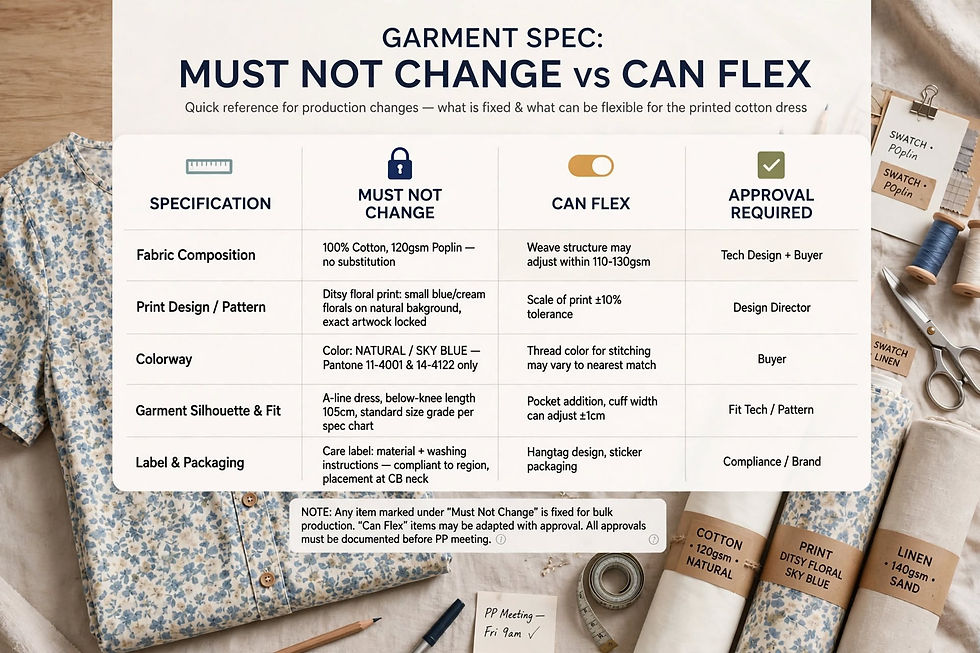
2. Introduce a Must Not Change vs Can Flex Page
A practical solution is to add one dedicated page to every tech pack.
This page should divide garment specifications into two categories.
A. Must Not Change
These are the specifications that define the identity, quality, performance or compliance of the garment.
They should not be altered without written approval from the buyer.
Examples include:
Specific fabric composition when required for product performance or labelling.
Critical colour standards.
Essential print artwork, scale and placement.
Key garment measurements and approved fit.
Required construction techniques.
Brand-specific trims, labels and hardware.
Mandatory testing or compliance requirements.
B. Can Flex
These are specifications where an alternative may be considered, provided it meets the agreed requirements and receives the necessary approval.
Examples include:
Alternative fabric suppliers with equivalent specifications.
A small GSM variation within an approved range.
Equivalent buttons or accessories.
Alternative thread brands with matching colour and performance.
Equivalent interlining options.
Approved alternative construction methods where the appearance, durability and function remain consistent.
Importantly, can flex does not mean the manufacturer has unrestricted permission to make substitutions.
It means the brand has already identified where alternatives may be evaluated.
Any change affecting the approved specification should be documented and approved before implementation.

3. Four Areas Where Unclear Flexibility Creates Problems
Some specifications require more attention than others. Fabric, trims, colour and construction are four areas where the absence of clear flexibility instructions can create unnecessary development rounds.
A. Fabric: Is the GSM Fixed or Is the Fabric Performance Fixed?
Fabric specifications often include composition, weight, weave, finish and construction.
However, brands do not always clarify which of these characteristics are critical.
For example:
A dress may specify 100% cotton at 120 GSM.
But what happens if a suitable alternative is available at 125 GSM?
Is that acceptable?
The answer depends on the garment, its intended drape, opacity, structure and end use.
A useful tech pack should specify:
Required composition.
Target GSM.
Acceptable GSM range, if any.
Fabric construction and weave.
Required hand feel and drape.
Shrinkage and colourfastness requirements.
Whether alternative fabric suppliers can be considered.
A manufacturer should never assume that a similar-looking fabric is automatically an acceptable replacement.
B. Trims: Does the Exact Component Matter or the Finished Appearance?
Buttons, zippers, drawcords, elastics and other accessories can appear relatively minor in a garment specification.
However, they can influence the overall product appearance and functionality.
For example, a printed blouse may require natural-looking buttons.
Does the brand require a specific button material and supplier, or would an equivalent button with the same appearance, dimensions and performance be acceptable?
The tech pack should clarify:
Exact trim specifications.
Material and dimensions.
Colour and finish.
Functional requirements.
Approved alternatives, if any.
Whether physical approval is required before bulk production.
C. Colour: Is the Reference Exact or Is There an Approved Tolerance?
Colour is particularly important in printed and dyed woven garments.
A brand may provide a Pantone reference, physical swatch or approved lab dip.
But the manufacturer also needs to understand how colour variations will be evaluated.
The specification should identify:
The master colour reference.
Whether a physical swatch takes priority over a digital reference.
Required colour approval stages.
Applicable colourfastness requirements.
Acceptable tolerance, where established.
Whether alternative dyeing or printing routes can be considered.
For printed garments, artwork colours and placement should also be clearly distinguished from the base fabric colour.
A substitution that looks close on screen may produce a noticeably different result on the actual fabric.
D. Construction: What Is Essential to the Design?
Construction instructions determine how a garment is assembled.
A tech pack may specify a particular seam, stitch type, neckline finish or sleeve construction.
However, not every construction detail carries the same importance.
For example, a particular seam finish may be essential for the garment's appearance, while another internal finishing method may allow an approved alternative without affecting the final product.
The tech pack should identify:
Required seam types.
Stitch specifications.
Critical finishing details.
Reinforcement requirements.
Construction methods that cannot change.
Alternative methods that may be evaluated.
The final garment must still meet the approved appearance, fit, durability and quality requirements.

4. What the Missing Page Should Actually Look Like
The additional page does not need to be complicated.
A simple table can help the buyer and manufacturer understand where decisions are fixed and where alternatives can be discussed.
Specification | Must Not Change | Can Flex |
Fabric composition | Required composition | Alternative only with approval |
Fabric GSM | Agreed target and tolerance | Approved variation within range |
Fabric supplier | Not necessarily fixed | Equivalent approved supplier |
Colour | Approved colour standard | Only within agreed tolerance |
Print artwork | Artwork and placement | No change without approval |
Buttons | Critical appearance and function | Equivalent approved alternative |
Stitching | Critical construction details | Approved equivalent method |
Interlining | Required garment performance | Equivalent approved option |
Labels | Brand identity and information | No unauthorised changes |
Finishing | Approved appearance and performance | Alternative only after evaluation |
The table above is illustrative. Actual requirements should be established for each garment and its intended use.
The most important part is adding a third column or reference field for approval requirements.
For example:
No substitution permitted.
Buyer approval required.
Physical swatch required.
Lab testing required.
Alternative permitted within specified tolerance.
This removes ambiguity before development begins.

5. Why This Page Can Reduce Unnecessary Sampling
Sampling is already a process involving multiple stages of evaluation.
A manufacturer may need to develop an initial prototype, evaluate fit, make corrections and prepare a pre-production sample.
When the original specifications are unclear, another problem enters the process: uncertainty about what can be changed.
Imagine the following situation.
A manufacturer submits a sample using a fabric that meets the specified composition but has a slightly different weight.
The buyer rejects it because the fabric feels too heavy.
The manufacturer sources another option and prepares a revised sample.
The buyer then requests a change to the buttons, followed by a correction to the neckline.
The next sample is delayed because several decisions are being made independently.
If the tech pack had already specified the acceptable fabric-weight range, trim alternatives and construction priorities, some of these discussions could have happened before the first sample was made.
This does not eliminate the need for sampling or technical evaluation.
It simply makes each development round more purposeful.
A clear specification helps make the first sample more accurate. A clear priority list helps make the next decision faster.

6. What Buyers Should Communicate Before Sending a Tech Pack
Before sending a development package to a manufacturer, buyers should check whether the document communicates both the product requirements and the decision-making boundaries.
A useful pre-development review should include:
Product identity
Is the final silhouette clearly defined?
Are the critical design details identified?
Are artwork and placement references available?
Fabric requirements
Is composition specified?
Is the GSM target clear?
Are acceptable alternatives defined?
Are performance requirements documented?
Trims and accessories
Are materials, dimensions and finishes specified?
Are equivalent alternatives permitted?
Is approval required before substitution?
Colour and print
Is there a master colour reference?
Are physical approvals required?
Are print scale and placement clearly communicated?
Construction
Are critical seams and finishing methods illustrated?
Are alternative methods permitted?
Are quality expectations documented?
Approval process
Who has final approval authority?
What requires written approval?
How will revisions be recorded?
Which specifications cannot change without authorisation?
The more clearly these questions are answered, the less room there is for interpretation during development.

7. What Manufacturers Should Do When a Specification Cannot Be Met
The responsibility does not sit entirely with the buyer.
Manufacturers should also have a structured process for dealing with sourcing or technical limitations.
When a specified material, trim or construction detail is unavailable or impractical, the manufacturer should:
Identify the exact specification that cannot be met.
Explain the reason for the limitation.
Suggest an alternative, where appropriate.
Compare the proposed alternative against the original requirement.
Highlight any implications for appearance, performance, cost or delivery.
Submit the alternative for buyer approval.
Record the approved revision before proceeding.
This is particularly important for printed and embroidered woven womenswear, where fabric behaviour, surface texture, print placement and construction can influence the finished garment.
A manufacturer should not independently replace an approved specification simply because an alternative is easier to source.
Equally, a buyer should recognise that a technically suitable alternative may sometimes be worth evaluating rather than delaying the entire development process.
The objective is to make informed decisions without compromising the product.

8. A Better Tech Pack Creates a Better Working Relationship
A strong manufacturing relationship is built on more than accurate measurements and clear construction instructions.
It requires both sides to understand the priorities behind the product.
The buyer should communicate what defines the garment, which specifications are non-negotiable and where alternatives may be considered.
The manufacturer should communicate sourcing limitations, technical possibilities and the implications of proposed changes.
When both sides understand these priorities, garment development becomes more structured, transparent and efficient.
Final Thought: Don't Just Tell Your Factory What You Want. Tell Them What Matters Most.
A detailed tech pack is essential. But detail without priorities can still leave important questions unanswered.
The next time you prepare a development package, add one more page.
List what must not change. Identify what can flex. Define the acceptable limits. Clarify who approves alternatives.
It may be one of the simplest additions to your tech pack, but it can make a meaningful difference to how your garment moves from concept to sample and eventually into bulk production.
The best tech packs don't just describe the garment. They guide the decisions required to make it.

Looking for an Apparel Manufacturing Partner Who Understands the Details?
At INDE EN VOGUE, we work with international fashion brands on garment development, sourcing and production, helping translate design requirements into commercially viable garments.
Our experience spans dresses, blouses, printed woven garments, embroidered styles, resortwear, coordinates and other womenswear categories.
From interpreting technical specifications and evaluating fabric options to coordinating sampling, construction and quality requirements, we understand the importance of getting the details right before bulk production begins.
We believe successful manufacturing partnerships are built on clear communication, technical understanding and shared expectations.
Whether you are developing a new collection, looking for a reliable apparel manufacturing partner or exploring sourcing and production opportunities in India, INDE EN VOGUE is ready to connect.
Let's take your next collection from development to production.
Website: https://www.indeenvoguedesigns.com/
Get in touch with INDE EN VOGUE to discuss your garment development and manufacturing requirements.


Comments